CEO's Corner: Pat Panaia
News
The leaders at MVF's portfolio companies have an immense amount of experience and expertise in their capacities scaling innovative startups in Maine. In our new series, The CEO's Corner, we are creating space for them to share their thought leadership ideas with the broader community. In our first article, Pat Panaia shares her perspective on how to build high performing teams.
The Best Tool I’ve Ever Learned to Manage Team Performance
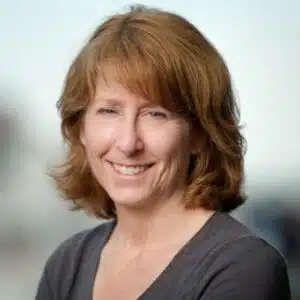
Pat Panaia is currently the CEO of Kinotek, a Maine startup that uses computer vision to measure human movement. The company has grown rapidly since she became CEO in 2022 and is now used by fitness, medical and sports professionals in 43 states and in Canada, Brazil, the Philippines and Belgium. Before Kinotek, Pat spent 30 years at two Maine animal health startups, IDEXX and Covetrus.
It wasn’t until two decades into my career that I was introduced to the best team management tool ever. It happened after three hot and humid days in the Maine woods, hiking, climbing, and completing mind-boggling team challenges with my colleagues at IDEXX.
It was the late 90s and IDEXX had grown exponentially. Some would say too fast. While the ride was incredible, along the way things broke. So Dave Shaw, IDEXX Founder and CEO, made a wise decision to send the management team into the woods. Teams were formed and thoughtfully mixed across departments.
The program was administered by Outward Bound. Our instructors were experts in outdoor survival. They were calm, patient, and excellent teachers.
Today, such “team building” is more common. I’ve done similar team building since the woods, even with similar exercises, but they were in a hotel ballroom, or some event space in town. Going into the Maine woods had a unique impact on my learning.
The Exercises
While we did many challenges, I’d like to describe one. The leaders had laid out a giant rope circle on the ground in a field. Part of our group was inside the circle with large blocks and other objects that were to be assembled. The rest of us stood outside the circle.
The Task: Those outside of the circle were to instruct those inside the circle on how to assemble the blocks. The Challenge: Those inside the circle were blindfolded.
Upon “Go!” chaos ensued. Everyone outside the circle started talking at once, and with any group of humans, leaders (or the loudest) emerged. Others retreated. Still others tried to contribute but gave up after they were drowned out.
Eventually, a plan emerged. A few outside the circle started issuing instructions.
“To your left, do you feel that box?” The inside person would move cautiously and find the box. “You’re going to need a partner. Sam! Can you move a bit to your right and help Harold?”
“What do you mean, twist it a little to the left? I’m doing that!”
Mistakes were made. Frustrations became apparent. The instructions became louder.
Eventually, time was called. Those on the inside took off their blindfolds and squinted as their eyes adjusted to the light. They surveyed their work, a bit confused.
Those on the outside crossed their arms. Looked down. Some mumbled.
No one was pleased with the results.
The Debrief
You might imagine the debrief. The instructors asked us what happened. We all sat on the grass like kindergartners. We were mostly silent, chastened by the experience. No one knew where to start. The instructors asked a different question.
“Did this exercise at all feel like how things are at work?”
The hands shot up.
“Absolutely!”
“If you’re not working at headquarters, it’s like you are blindfolded.”
“Everyone was shouting instructions at once. We didn’t know who was in charge.”
“I didn’t understand what we were trying to accomplish.”
The Best Tool Ever
After three days (and two nights sharing cabins), all groups gathered in the evening for a debrief of the entire three days. We were about 50, scattered on the main cabin floor, legs hanging over the loft balcony, sharing benches, leaning against the walls. It was hot. The instructors were patient. They asked the group the same questions as after the exercises. We kept giving the same answers.
They kept pressing: what’s the real problem?
We sat there for three hours. It was past midnight, and finally, finally, we had a breakthrough.
The Best Tool Ever to Manage Teams
Like a riddle, after you learn the answer it looks simple. In every new team I’ve worked with, I introduce this model and it becomes our roadmap for team success. Without exception, in my remaining career and at my latest venture, anyone who wasn’t in the Maine woods with me has not heard of this tool. The acronym is GRIP.
G = Goals
R = Roles
I = Interpersonal
P = Process
Anytime I start working with a team, whether on a new initiative or an existing one, I go right to this model. I guarantee, one or more parts of the model has not been established. Always to my surprise, the biggest gap is lack of alignment and understanding of the team’s goals and roles. Had we used this model with our blindfolded colleagues, I guarantee the outcome would have been success. A few more comments:
ALWAYS start with the Goals. Do goals exist? Are they clear and measurable? Does everyone understand them? Goal clarity involves the ability to measure the outcome over a specified time period. Often there’s a generic goal that is not measurable and/or time bound. You’d be surprised when teams are not working well, it turns out that not everyone understands the goals or they do not have aligned goals.
Roles. Is everyone clear on their roles? What exactly is their contribution to achieving the goal? Who’s the leader? Who are followers?
Interpersonal. Have we agreed “how” we’ll interact with one another?Are we all using Slack, texting or email or all three? Is it OK to text after work hours and on weekends? What’s the best way to express frustration? Is it OK to swear? How will we handle conflict?
Process. Do we have a process to “write down” and document our plan, to meet, to measure against our goals, to communicate feedback, and to mark achievement of milestones? How often will we report to the Board or others on the team? Who runs the meetings? While “interpersonal” includes handling conflict, I recommend a process for this also.
I share the GRIP model because it is my #1 “go to” tool to start any project, or for when I step into an existing initiative. It should be required for any leader managing any team.
I guarantee it works and hope you use it and find the same amazing results with it that I have.
About Maine Venture Fund
Maine Venture Fund invests in Maine businesses that have the highest potential for growth and impact. For more information, visit maineventurefund.com.
Inquiries:
Terri Wark
Maine Venture Fund
(207) 305-0006
terri@maineventurefund.com