
The Fundamentals of Product-Market Fit
News

Jess Mayhew is consultant who helps startups define and find product-market fit, among other growth-related strategies. After we met her and learned about her story we asked her to pen a newsletter post for our audience given the fact that every company struggles with this at some phase in the startup journey. We think you’ll enjoy her perspective and we encourage any companies seeking help to leverage her expertise!
The Fundamentals of Product-Market Fit: A Guide for Maine Entrepreneurs
Product-market fit is often cited as the holy grail of startup success, yet it remains one of the most elusive concepts in entrepreneurship. For founders in Maine's growing startup ecosystem, understanding and achieving product-market fit can mean the difference between building a sustainable business and burning through resources without traction.
My Journey to Understanding Product-Market Fit
Before being professionally trained by Amy Jo Kim—a Silicon Valley-based three-time founder who's worked on hundreds of products including eBay, The Sims, Bejeweled, Netflix, and Disney—I worked tirelessly trying to understand how to achieve product-market fit. Working as the founding product manager at an early-stage femtech startup, I was responsible for guiding our products toward market fit, but I struggled to find a clear, systematic approach. I read books, blogs, and articles, and attended seminars, but always left with more questions than answers.
Finally, I found Amy Jo, who taught me the systematic process she developed after working on famous hits and founding her own companies. It was a process that made my engineer heart happy: clear loops with success criteria at each step. I now use this framework with consulting clients who are developing new products, have existing products that aren't getting traction, or are looking to spin off from their core offerings.
What is Product-Market Fit?
At its core, product-market fit is deceptively simple: it's building what people want and are willing to purchase. I often use these metaphors to explain it:
It's a liquid, not a solid — it exists on a spectrum and evolves as your business grows
It's a journey, not a checkbox — like fitness, it requires ongoing attention
Product Market Fit exists on a spectrum and evolves as your business grows. True product-market fit goes beyond having users who enjoy your product. It means you've created something that customers actively choose over alternatives at a rate that supports sustainable business growth. It's the sweet spot where your solution perfectly addresses a real market need in a way that customers find compelling enough to pay for repeatedly.
Four Signs You Have Product-Market Fit
1. Low Churn, High Retention
One of the clearest signals of product-market fit is customer retention. If you can sell your product but experience high churn rates – losing more customers than you're gaining or keeping – you likely don't have true product-market fit yet. Sustainable businesses see customers stick around because the value proposition is clear and compelling.
2. Market Pull, Not Push
When you have product-market fit, you'll feel the market pulling your product from you rather than you having to push it into the market. Look for:
Customers actively seeking out solutions like yours
Word-of-mouth referrals driving organic growth
Difficulty keeping up with demand
Customers expressing disappointment if they couldn't use your product anymore
3. Sustainable Revenue Model
Product-market fit isn't just about usage – it's about building a business. Key financial indicators include:
Customers willing to pay at price points that support your business model
Revenue growth that outpaces customer acquisition costs
Clear path to profitability with your current model
4. The "40% Rule" (not to be confused with the Rule of 40)
A famous metric asks customers: "How disappointed would you be if you couldn't use this product anymore?" and they answer from very disappointed to not disappointed. If 40% or more respond "very disappointed," it's often considered a strong indicator of product-market fit. While not a hard and fast rule, this metric helps gauge emotional attachment to your solution.
So, How Do I Start Developing Product Market Fit? Start with the Fundamentals: Know Your Ecosystem (Buyers, Users and Competitors)
Before diving into product development, you need to understand the market ecosystem you're entering. Ask yourself these critical questions:
Who’s going to buy my product?
Who specifically has purchasing power in your target market?
How do they discover new solutions?
What alternatives are they currently considering?
How do they define and measure value (time savings, cost reduction, improved outcomes)?
Who’s going to use my product?
Are the buyers and users the same people?
What specific problems does your solution solve for users?
Which segment of your users are the highest need, early adopters?
How do buyers know your solution will actually solve user problems?
Who are my competitors?
What are your potential customers utilizing today to solve this problem? What are the alternatives?
Are you convincing them they have a problem, or do they already know they have a problem and need a better solution?
The Iterative Approach to Finding Product Market Fit
Validate the Problem
Before building anything significant, ensure you're solving a real problem that people actively want solved. Look for signs that potential customers are already trying to solve this problem with makeshift solutions or incomplete alternatives.
Test with Minimal Viable Solutions
Start small and test core product assumptions quickly. Rather than building a full product, create minimal viable versions that test your key high risk hypotheses about what customers want and need.
The Power of Low-Fidelity Testing
When testing early concepts with potential customers, resist the urge to create polished, high-fidelity prototypes. Instead, use low-fidelity mockups – think black and white wireframes or simple sketches. You can use Claude or another AI alternative to help develop these. This approach offers two critical advantages:
Avoid Design Distractions: You don't want feedback about colors, fonts, or graphics at this stage. Those design elements, while important later, can derail conversations about core functionality and value proposition.
Encourage Honest Feedback: People naturally want to be helpful and avoid hurting feelings. When you show them something that looks "finished" or polished, they're more likely to offer polite, surface-level feedback rather than the raw, honest critique you actually need. Low-fidelity prototypes signal that you're still in exploration mode and genuinely want their input on fundamental assumptions.
Remember: at this stage, you're not testing whether people like your design – you're testing whether they understand and value what you're proposing to build.
Design Around the Core Habit Loop
Since retention is a key indicator of product-market fit, start your product development by defining the core habit loop – how users will engage with your product on a regular basis. This might be daily (like a communication tool), weekly (like a project management platform), monthly (like financial planning software), or even yearly (like tax preparation software).
Once you've defined this core usage pattern, work backward through the user journey:
Core Habit Loop: What specific actions will users take repeatedly? What value do they get each time? What triggers them to use your product or service?
Onboarding: How do you get users from first sign-up to experiencing that core value loop for the first time?
Discovery: How will potential users find your product? What marketing channels and messaging will resonate?
Then skip ahead to design for
Mastery: What will keep power users engaged 6 months from now? How does your product evolve with users as they become more sophisticated?
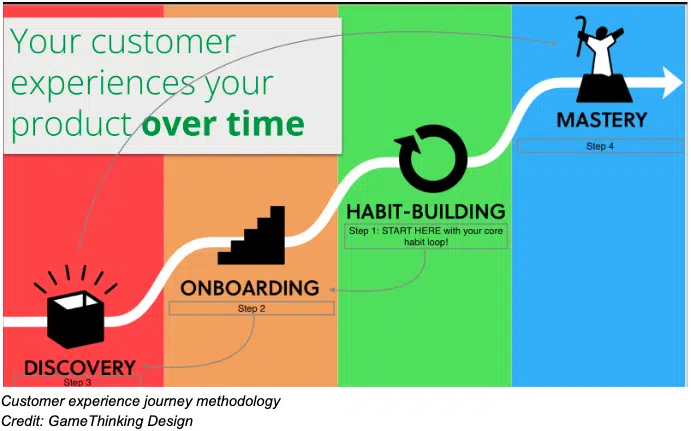
This graphic outlines the GameThinking Design customer journey methodology and in what order to approach designing each step. This approach ensures you're not just thinking about initial onboarding, but designing for the sustained engagement that true product-market fit requires.
Focus on Superfans (High-Need Early Adopters)
Superfans have three characteristics:
they have the problem
they know they have the problem
they are actively looking for solutions to solve the problem
These early adopters are living in the future, open to trying new solutions, and feel the pain most acutely. They're more likely to try imperfect solutions and provide valuable feedback.
Measure and Iterate
Track the metrics that matter for your business model. Some examples include:
Customer acquisition cost vs. lifetime value
Usage patterns and engagement metrics
Retention and churn rates
Revenue per customer
Net Promoter Score and customer satisfaction
Common Pitfalls to Avoid
The "Nice to Have" Trap
Many products fail because they solve problems that are merely inconvenient rather than truly painful. If customers can easily live without your solution, you'll struggle to achieve sustainable product-market fit.
Ignoring the Implementation Reality
Sometimes a solution looks perfect on paper but fails in real-world implementation. For example, a B2B tool might require significant time investment from already overworked employees, leading to poor adoption despite solving a genuine problem.
Confusing Product-Market Fit with Early Traction
Having some customers who love your product doesn't necessarily mean you have product-market fit. Look for patterns of sustainable, scalable growth rather than isolated success stories.
Final Thoughts to Leave You With
Product-market fit isn't a destination but an ongoing process. Markets evolve, customer needs change, and new competitors emerge. The companies that thrive are those that continuously validate and refine their understanding of what their market truly needs.
For founders looking to dive deeper into these concepts, I recommend three books that have shaped my approach:
Game Thinking by Amy Jo Kim for a comprehensive look at the engagement design methodology I've described here.
Pattern Breakers by Mike Maples Jr. and Peter Ziebelman, which offers illuminating insights into how breakthrough startups actually achieve product-market fit by defying conventional wisdom.
The Mom Test by Rob Fitzpatrick for mastering customer discovery conversations that actually reveal truth rather than polite validation.
The path to product-market fit starts with asking the right questions, staying close to customers, and being willing to pivot when the data suggests a different direction. By focusing on these fundamentals, startups can build sustainable, scalable businesses that stand the test of time.
Product-market fit doesn't have to be elusive. If you want help establishing product-market fit, building products with high retention, and validating ideas faster, I'd love to connect. I work with startups and founders to turn these frameworks into actionable strategies. Reach out at jessmayhew55@gmail.com, find me on LinkedIn, or see examples of my work at https://pm-portfolio-showcase-site.lovable.app/
About Maine Venture Fund
Maine Venture Fund invests in Maine businesses that have the highest potential for growth and impact. For more information, visit maineventurefund.com.
Inquiries:
Terri Wark
Maine Venture Fund
(207) 305-0006
terri@maineventurefund.com